AI-Generated Zero-Days Show Why Logic Flaws Are the Next AppSec Risk
Google says threat actors likely used AI to develop a zero-day 2FA bypass in an open-source admin tool.
By Abhay Mittal
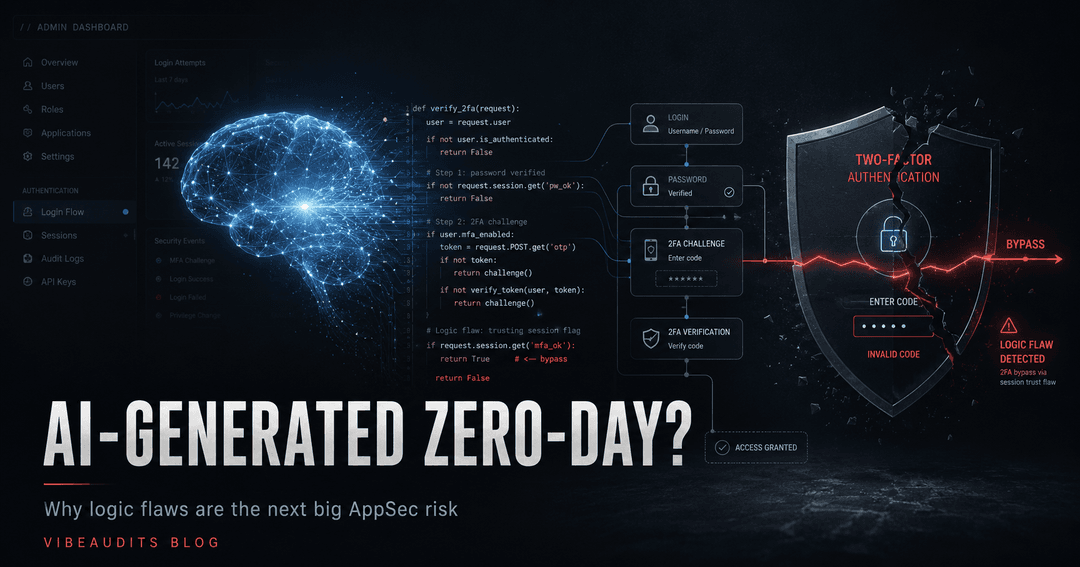
Google Threat Intelligence Group just reported something security teams should not ignore: a threat actor used a zero-day exploit that Google believes was developed with AI.
The exploit targeted a popular open-source, web-based system administration tool. It was written in Python and allowed a 2FA bypass, although the attacker still needed valid user credentials first. Google did not publicly name the tool or the threat actor, but it says the vulnerability was responsibly disclosed and the planned mass exploitation campaign may have been disrupted.
This is not just another zero-day story. The important part is the type of bug AI helped find.
This Was Not a Normal Scanner-Friendly Bug
Most security tools are good at finding familiar patterns: unsafe input handling, known vulnerable dependencies, exposed secrets, memory corruption, missing headers, or obvious misconfigurations.
This case was different.
Google described the vulnerability as a high-level semantic logic flaw. It means the code technically worked, but its security assumptions were wrong.
Somewhere in the authentication logic, the system had a hardcoded trust assumption that contradicted how 2FA enforcement was supposed to work.
That is exactly the kind of bug traditional scanners often miss.
A static scanner can flag dangerous functions. A dependency scanner can flag known CVEs. But a logic flaw requires understanding the developer's intent, the expected security flow, and the hidden contradiction in the code.
That is where LLMs are becoming dangerous.
The Exploit Had AI Fingerprints
Google says it does not believe Gemini was used, but it has high confidence that an AI model supported the discovery and weaponization of the flaw.
The indicators are interesting. The exploit script had:
- Verbose educational docstrings
- A hallucinated CVSS score
- A very structured Python style that looked like textbook training data
These are small details, but together they made the script look less like a rushed human exploit and more like something generated or heavily assisted by an LLM.
That does not mean every cleanly written exploit is AI-generated. But it does show where things are heading.
Attackers do not need AI to be magical. They need it to be useful enough to reduce time, reduce skill requirements, and help them reason through unfamiliar codebases faster.
That is already happening.
Why This Matters for AI-Built Apps
This is especially relevant for teams building fast with AI coding tools.
AI-generated applications often look polished on the surface. The UI works. The routes load. The dashboard feels complete. But underneath, the app may contain fragile assumptions around auth, tenant isolation, admin access, payments, webhooks, and background jobs.
These are not always syntax bugs. They are design bugs.
A few examples:
- A route assumes the frontend already checked permissions.
- A webhook trusts metadata that can be manipulated.
- An admin endpoint checks whether a user is logged in, but not whether they are actually an admin.
- A 2FA flow has one exception path that quietly bypasses the intended enforcement.
- A multi-tenant app filters by user ID in most places, but misses one privileged query.
These are the kinds of flaws that make vibe-coded and AI-assisted apps risky. They are also the kinds of flaws that LLMs can increasingly help attackers find.
The Takeaway
The lesson is not to stop using AI to build software.
The lesson is that AI-assisted development needs AI-aware security review.
If your app was built quickly with Cursor, Claude Code, Replit, Lovable, Bolt, or any similar tool, you should assume there may be logic paths nobody has deeply reviewed — especially around:
- Authentication and authorization
- Admin tools
- Payment flows
- File access
- Tenant boundaries
The next wave of security risk will not only come from missing patches or exposed API keys.
It will come from code that looks correct, passes tests, ships to production, and still has one broken assumption hiding inside the business logic.
That is the part attackers are starting to automate. And that is the part every serious team needs to audit before users, customers, and sensitive data are on the line.