Data Privacy Isn’t Compliance: What Startups Need for Enterprise Sales
Enterprise buyers evaluate security before buying. Learn what data privacy, SOC 2, ISO 27001, HIPAA, GDPR, PCI DSS, and compliance automation really mean—and what your startup must fix before audits and sales conversations begin.
By Abhay Mittal
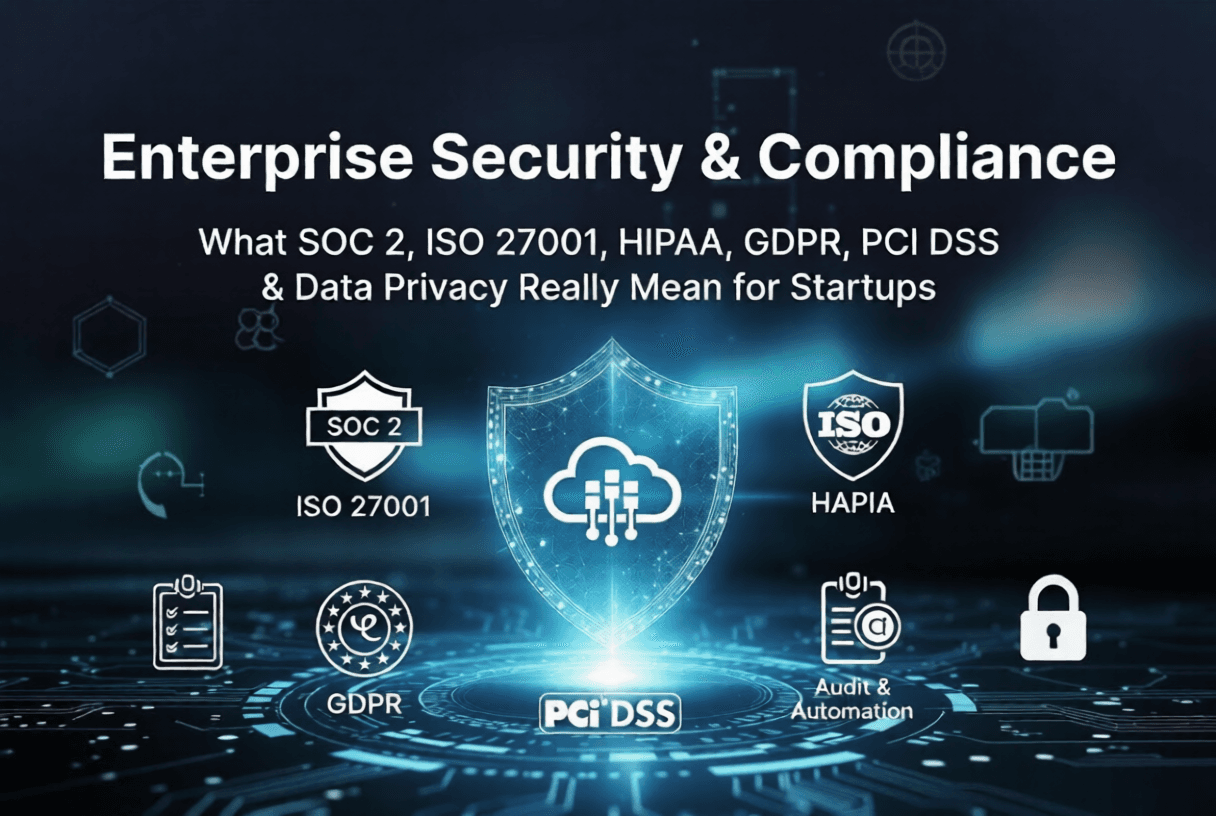
Data Privacy, SOC 2, ISO 27001, HIPAA, GDPR, PCI DSS & Compliance Automation
What Startups Actually Need Before Enterprise Customers Say Yes
Introduction
Enterprise customers evaluate security and compliance much earlier than most startups expect. Questions around data privacy, SOC 2, ISO 27001, HIPAA, GDPR, PCI DSS, and compliance automation often appear before serious sales conversations begin.
At first glance, these requirements look like a checklist of certifications and tools. In practice, they represent something more fundamental: trust in your product’s ability to handle sensitive data and operate securely under real-world conditions.
Many startups focus on obtaining certifications or adopting compliance tools. However, enterprise buyers are not assessing whether you have purchased the right software or generated the right documents. They are evaluating whether your system is designed, built, and maintained with strong security principles.
This creates a gap between being “compliance-ready” and being audit-ready.
Understanding the Difference Between Frameworks
These terms are related but serve different purposes:
- GDPR: Legal framework governing how personal data is collected, processed, and stored.
- HIPAA: Defines safeguards for protecting healthcare data (PHI).
- ISO 27001: Standard for building and maintaining an information security management system (ISMS).
- SOC 2: Audit framework evaluating security, availability, processing integrity, confidentiality, and privacy controls.
- PCI DSS: Security standard for handling payment card data.
- Compliance Automation: Tools that help manage documentation, evidence, and audit workflows.
Misunderstanding these frameworks leads to solving the wrong problems—focusing on policies instead of system design, or tools instead of controls.
What Enterprise Buyers Are Actually Evaluating
When buyers raise compliance questions, they are typically assessing:
Data Handling
- What data is collected?
- Where is it stored and processed?
- Who has access?
- Can it be deleted or restricted?
Security Maturity
- Are access controls well-defined and enforced?
- Are systems designed to prevent misuse or unauthorized actions?
- Are processes repeatable and auditable?
Risk Exposure
- Can sensitive data be leaked or misused?
- Are payment flows isolated and secure?
- Are critical systems protected against common failure scenarios?
These concerns are grounded in the actual behavior of your system—not in documentation alone.
Role and Limitations of Compliance Automation
Compliance automation platforms provide value in operational efficiency:
- Centralizing policies and controls
- Mapping requirements across frameworks
- Collecting and organizing audit evidence
- Tracking ownership and progress
However, they do not validate whether your system is secure.
They cannot:
- Detect broken authorization logic
- Identify insecure API design
- Evaluate business logic vulnerabilities
- Assess real-world attack scenarios
Automation supports compliance processes, but it does not replace security engineering or audit validation.
Common Failure Points in Startup Systems
Security gaps are usually not caused by a single critical flaw, but by multiple smaller issues:
Access Control
- Overly broad roles and permissions
- Inconsistent enforcement across services
API and Backend Design
- Unprotected endpoints
- Insufficient input validation
- Trusting client-side data
Secrets Management
- Hardcoded credentials
- Poor environment separation
- Insecure storage of API keys
Payment Integrations
- Unverified webhook events
- Weak validation of external inputs
Data Management
- Storing unnecessary sensitive data
- Lack of retention and deletion controls
Logging and Monitoring
- Incomplete or non-actionable logs
- Limited visibility during incidents
AI and Automation Risks
- Prompt injection vulnerabilities
- Unrestricted access to internal systems via workflows
These issues often remain unnoticed until a formal security review or enterprise audit exposes them.
What a Real Readiness Audit Should Cover
A meaningful readiness audit evaluates how your system behaves under realistic conditions.
Key Areas
- Authentication mechanisms
- Authorization and role enforcement
- Data flow and storage practices
- API security and validation
- Infrastructure configuration
- Secrets management
- Payment processing flows
- Logging and monitoring
- Edge case and abuse scenarios
- AI-specific risks (if applicable)
Core Questions
- What happens if a user misuses the system?
- What if access tokens are compromised?
- What assumptions could fail under stress?
- What are the consequences of those failures?
This approach focuses on identifying real risks rather than verifying documentation.
Compliance vs Security Reality
Compliance vs Security Reality
Compliance Indicator → Security Reality
- Policies are documented → Controls are enforced
- Logging is enabled → Logs are actionable
- Access is defined → Access is correctly restricted
- Audit is completed → System is resilient under attack
Meeting compliance requirements does not guarantee that a system is secure in practice.
Keep reviewing your app
Practical checks for the parts of an AI-built app that handle real users and money.
Vibe-coded app security checklist
Work through 25 checks before accepting real users, payments, and private data.
How to review vibe-coded apps
Plan a review, test the risky flows, and decide when you need a professional audit.
Free vibe code security check
Answer 15 questions to score your app's launch risk and see what to fix first.
Need a second pair of eyes? Explore our code audit services, scope and pricing, and client case studies.