GitHub Got Breached. Your Vibe Coded App Is Next.
GitHub is investigating an internal breach. Vibe coded apps built on Cursor, Claude Code, and npm are exactly what attackers are hunting right now.
By Abhay Mittal
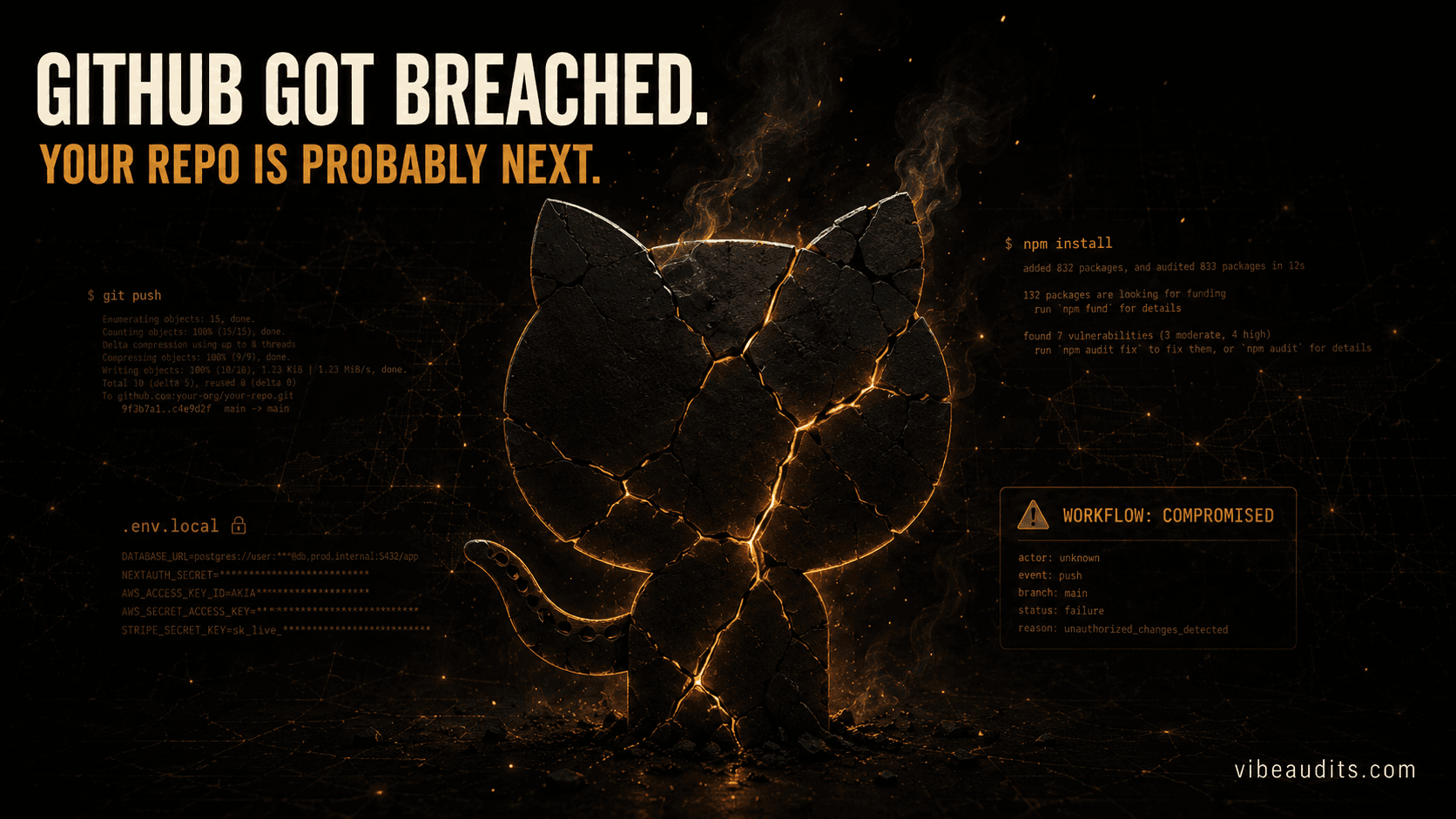
On the evening of May 19, 2026, GitHub is investigating unauthorized access to their own internal repositories. No evidence yet that customer enterprises, organizations, or repositories were touched. They are monitoring. They will notify if that changes.
If you ship fast with Cursor, Claude Code, and npm, this is not just news. It is a signal.
What actually happened
GitHub has internal repos like everyone else. Those got accessed by someone who was not supposed to be there. Scope is still being figured out.
The bigger story is the context around it.
In the last six weeks the GitHub ecosystem has taken hit after hit. Wiz disclosed CVE-2026-3854, a critical injection flaw in GitHub's git pipeline that exposed millions of repositories. Grafana Labs confirmed an attacker downloaded its codebase using a leaked token from a misconfigured Actions workflow. TeamPCP, the group behind the Shai-Hulud worm, open sourced their malware on GitHub and ran the Mini Shai-Hulud campaign through compromised npm packages including TanStack, Mistral AI, Guardrails AI, and OpenSearch.
OpenAI confirmed two employees were hit. Mistral AI repos were allegedly listed for sale on a hacker forum for $25,000.
GitHub announcing an internal breach in the middle of all that is not a coincidence.
Why this matters for vibe-coded apps
If you built your product in the last twelve months, your security perimeter is some combination of these. A repo with secrets in .env.local you forgot to scrub. A .github/workflows folder copy pasted from a tutorial. An npm dependency tree you have never read. A Cursor or Claude Code session with full read access to all of it. Vercel, Supabase, or Stripe tokens stored as repo secrets.
That is the exact attack surface Mini Shai-Hulud is hunting. The worm targets npm tokens, GitHub PATs, cloud credentials, CI/CD secrets, and Claude Code configurations. It writes stolen data to new public GitHub repos with names lifted from Dune novels.
The GitHub breach does not change your risk directly. It changes the confidence level. Treat it as a deadline, not a headline.
What to do this week
Rotate every token in your GitHub account. PATs, fine grained tokens, OAuth apps, deploy keys. If you have not rotated in 90 days, assume one is stale.
Audit repo secrets. Settings, Secrets and variables, Actions. Delete what you do not need. Rotate what you do.
Run a secret scan with Trufflehog, gitleaks, or GitHub's own scanner. It will find keys you forgot you committed.
Check .github/workflows for unsafe patterns. pull_request_target with checkout of untrusted code, secrets passed to fork scripts, third party actions pinned to floating tags instead of commit SHAs. Each is how Grafana, OpenAI, and TanStack got hit.
Lock down npm. Use npm ci in production, pin versions, run npm audit. If you use any package in the Mini Shai-Hulud target list, check your lockfile.
If you use Claude Code or Cursor, check your config files for anything you did not put there. Shai-Hulud specifically modifies AI agent configs to add execution hooks.
The point
You do not get to outsource your security to GitHub. GitHub just proved that themselves.
The companies getting hit are not running ancient PHP. They are AI native teams shipping with the same tools you use.
A two hour audit today costs nothing. Skipping it until your AWS keys show up in a Dune themed exfil repo costs everything.
If you want a second set of eyes on your repo, CI/CD, or AI agent setup, that is what we do at VibeAudits.
Keep reviewing your app
Practical checks for the parts of an AI-built app that handle real users and money.
Vibe-coded app security checklist
Work through 25 checks before accepting real users, payments, and private data.
How to review vibe-coded apps
Plan a review, test the risky flows, and decide when you need a professional audit.
Free vibe code security check
Answer 15 questions to score your app's launch risk and see what to fix first.
Need a second pair of eyes? Explore our code audit services, scope and pricing, and client case studies.