Redis RCE CVE-2026-23479: Is Your Config the Real Risk?
An AI tool found a use-after-free RCE in Redis (CVE-2026-23479) hiding since 2023. For vibe-coded apps, the real danger is an exposed or misconfigured Redis instance.
By Abhay Mittal
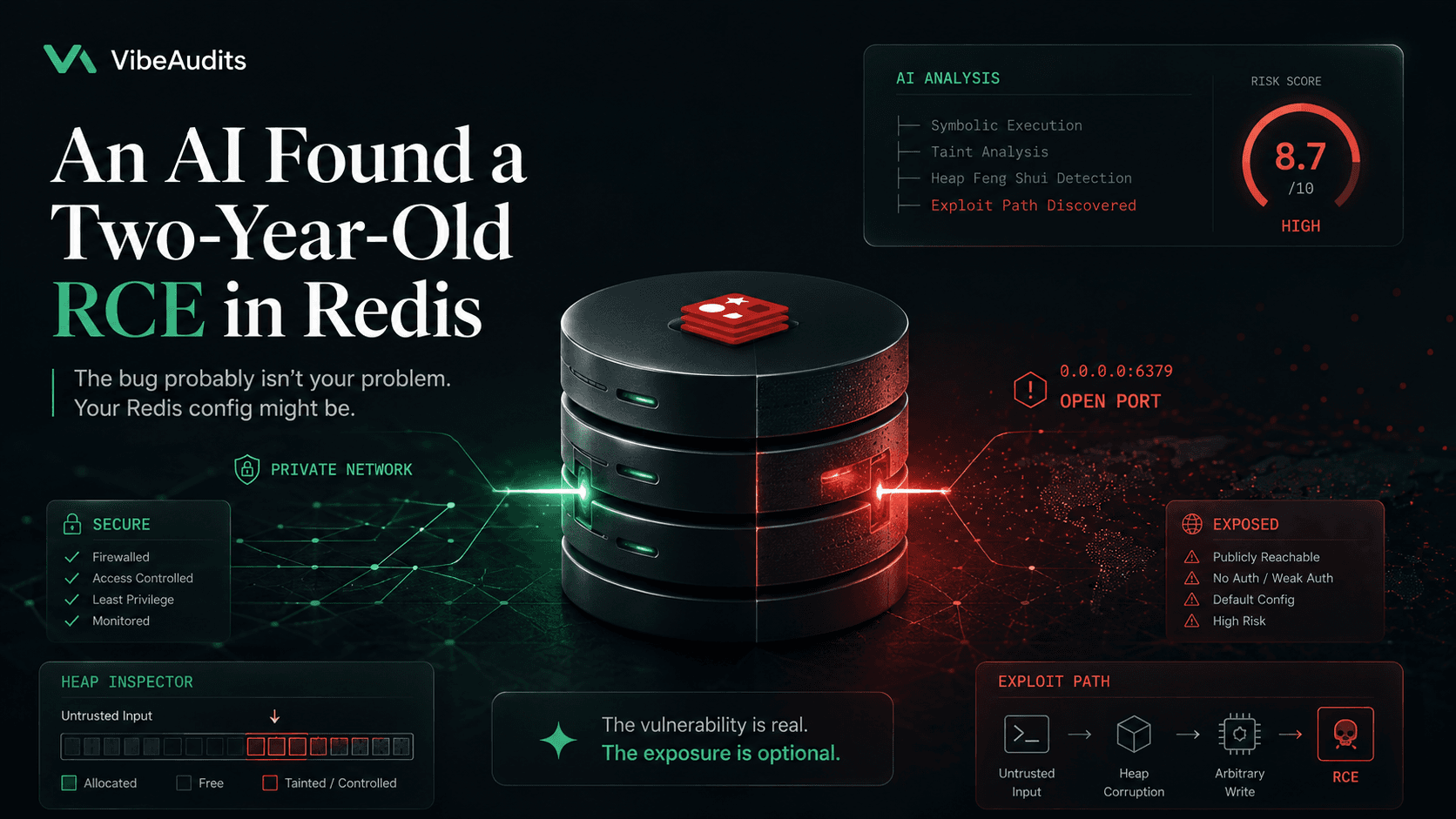
An autonomous AI security tool called Team Xint Code turned up a remote code execution flaw in Redis that had been sitting in the codebase since 2023. The bug, tracked as CVE-2026-23479, survived more than two years of human review before a machine spotted it.
The part that matters for your app is quieter: whether an attacker can ever reach the bug at all comes down to how you configured Redis.
What the bug is
Redis lets clients run blocking commands like BLPOP that pause until data shows up. When the server unblocks that client and re-runs the command, it failed to check for one specific error. If the client got evicted mid-flow, Redis kept using a chunk of memory it had already freed. That is a use-after-free, and a careful attacker can shape memory around it to take control.
It was rated between 7.7 and 8.8 depending on the scoring system, and patched on May 5, 2026 across the 7.2, 7.4, 8.2, 8.4, and 8.6 branches.
Why your app might be fine
Here is the catch the scary headline skips. This is an authenticated attack. To pull it off, someone needs network access to your Redis instance and a session with real privileges: the ability to run config changes, Lua scripts, and stream commands from one connection.
If your Redis sits on a private network behind your app, with authentication on and scripting locked down, the path to this bug is mostly closed. Patch it anyway, but you were never the easy target.
Why your app might not be
Now the uncomfortable part. The single most common mistake in AI-built apps is a Redis instance exposed straight to the internet with no password or a default one. Vibe coding tools spin up a cache or a queue in seconds and rarely stop to lock the door behind it.
If that describes any instance you run, this CVE is the least of your worries. An open Redis is already a full compromise waiting to happen. The use-after-free just hands a motivated attacker a cleaner way in.
The real lesson
An AI found this bug because machines are now good at scanning mature C codebases for memory corruption. That is a real shift, and it means more findings like this are coming.
So patch Redis to the fixed release for your branch. Then have someone actually look at how your data layer is wired, because the bug an AI finds in the library is rarely the one that takes you down. The one that takes you down is usually the open port nobody reviewed.
VibeAudits runs manual, black-box reviews of vibe-coded apps and the infrastructure behind them, the kind of look that catches an exposed Redis before an attacker does. If you are not sure what your data layer looks like from the outside, that is exactly what we check.
Keep reviewing your app
Practical checks for the parts of an AI-built app that handle real users and money.
Vibe-coded app security checklist
Work through 25 checks before accepting real users, payments, and private data.
How to review vibe-coded apps
Plan a review, test the risky flows, and decide when you need a professional audit.
Free vibe code security check
Answer 15 questions to score your app's launch risk and see what to fix first.
Need a second pair of eyes? Explore our code audit services, scope and pricing, and client case studies.